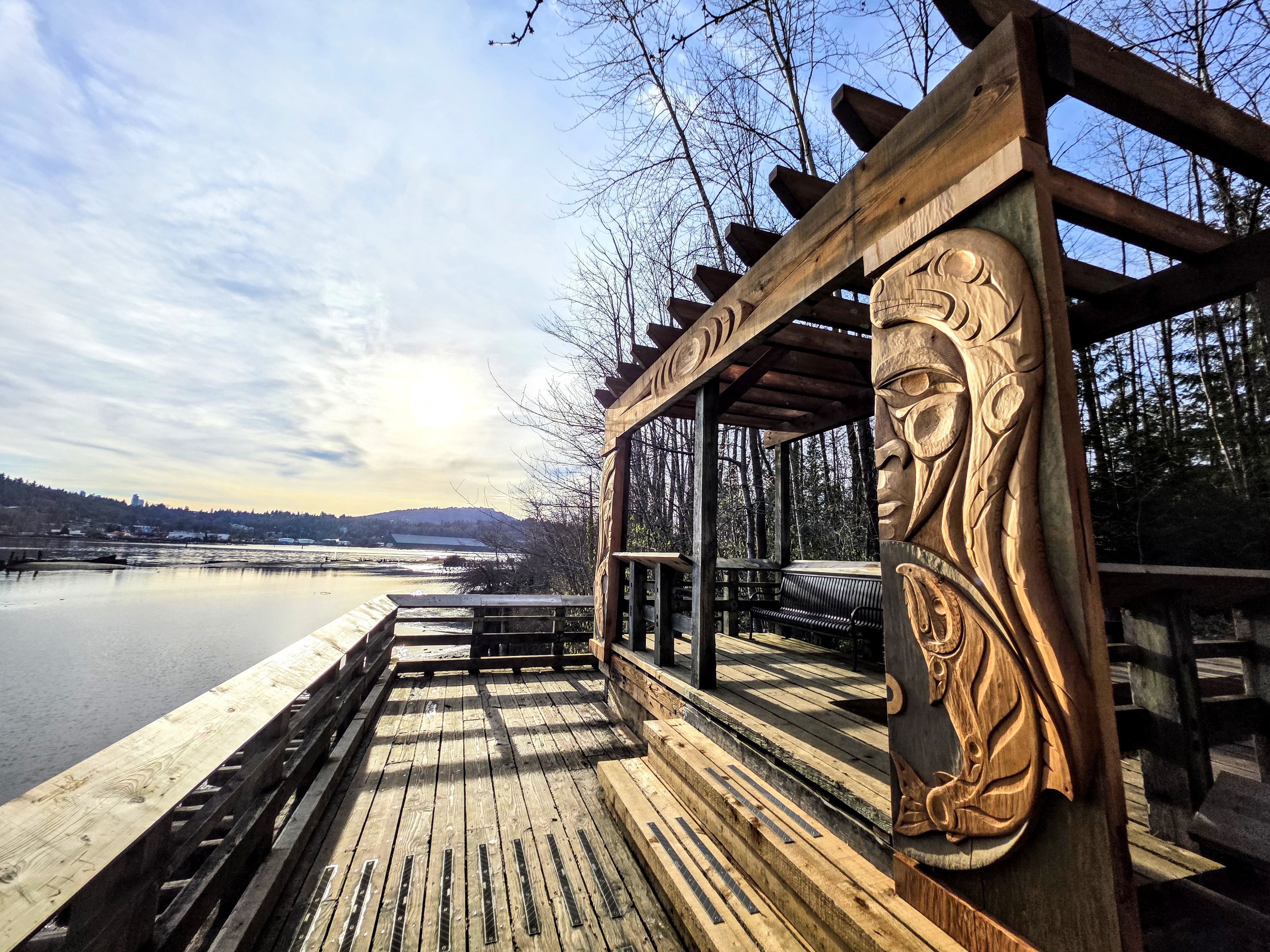
Shoreline Trail House Posts

In the Presence of Ancestors

In 2017, Coast Salish artist and Port Moody resident, Tasha Faye Evans, began a journey with a project titled The Welcome Post Project, which included a series of community engagement opportunities and educational sessions along with the carving of a house post at the Noons Creek Hatchery. That beautiful house post, Saymahmet, by Squamish artist and carver James Harry, was raised in ceremony at Rocky Point Park and installed at Noons Creek Hatchery in 2018.

The Welcome Post Project was the inspiration for In the Presence of Ancestors, which is a project that reasserts the presence of the original caretakers of the Coast Salish lands and waters in and around the place we now call Port Moody. In the Presence of Ancestors has offered a variety of community engagement opportunities over the last five years, and the project will culminate in 2025/2026 with the raising of five house posts from Coast Salish Nations along Port Moody’s Shoreline Trail, between Rocky Point Park and Old Orchard Park. 

Carvers from səlilwətaɬ (Tsleil-Waututh), kʷikʷəƛ̓əm (Kwikwetlem), xʷməθkʷəy̓əm (Musqueam), q̓ic̓əy (Katzie), and Sḵwx̱wú7mesh (Squamish) Nations have carved unique house posts that will restore a highly visible First Nations presence in the community. Installed facing the water, the house posts remind our community of our shared responsibility for protecting the Burrard Inlet. Each installation site will be designed as a space for learning and reflection and will include signage, in Salishan languages, sharing words from the carvers and the vision for the future of Coast Salish Lands and Waters. 

The City of Port Moody is proud to support In the Presence of Ancestors and thanks artistic director Tasha Faye Evans and everyone involved for their work on this important project. We are also grateful to the Noons Creek Hatchery for providing In the Presence of Ancestors with ongoing support, including space for dialogue, learning, carving, and ceremony.

“Port Moody resides within the beautiful ancestral lands and waters of the Coast Salish people. Many positive changes towards redress, truth-telling and reclamation of Indigenous values are happening in our city with softness of healing slowly rippling throughout all of our communities. In the Presence of Ancestors is an effort to carve these changes permanently into the legacy of Port Moody and create a path of healing for all of our relations.”

~ Tasha Faye Evans

House posts

Title: Grandmother's Prayer

Artist: Zachary George

Narrative: "Grandmother's Prayer" is a dedication to səlilwət for sustaining our relations for millennia.

Paying tribute to the səlilwətaɬ, matriarchs, "Grandmother's Prayer" is carved with sqwelqwel about the women who swam in these waters during the full moon. With prayers in their hearts, women would swim in the moon's path and return to shore with messages of guidance for the community. This practice was passed down to young girls during their transition to womanhood.

With sʔi:ɬqəy̓, the two-headed sea serpent, carved at its top, this qeqen stands as a guardian for the inlet.

"Grandmother's Prayer" asserts a vision of stewardship of these waters for future generations to thrive, including Orca, Salmon, and all marine species calling səlilwət home. The səlilwətaɬ first grandmother was born from these waters. Her grandchildren remain dedicated to protecting, stewarding, defending, and maintaining the health of səlilwət.

Water is life. Water is sacred.

Installation: May 2026

Location: Rocky Point Park looking out onto the Burrard Inlet. This post will mark the beginning of the trail along the shore to the following house posts.
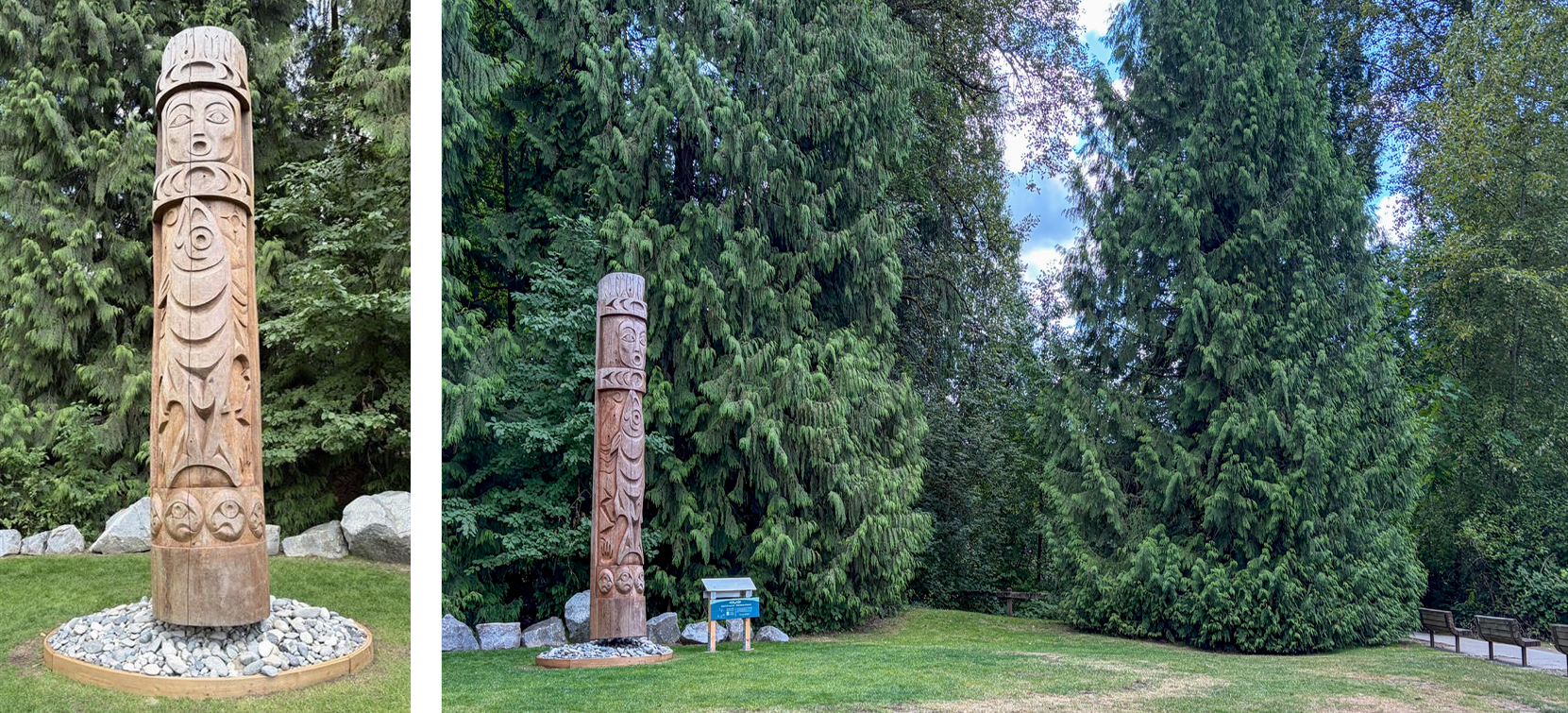
 

Title: Spirit of Kwikwetlem

Artist: Brandon Gabriel in collaboration with the community at Kwikwetlem First Nation. Carved by Brandon Gabriel, Jonas Bije, Lekeyton and the Port Moody Ecological Society community.

Narrative: “Spirit of Kwikwetlem” stands facing Coquitlam Mountain, the source of our tap water. Before falling in a windstorm, this tree grew on this mountain in kʷikʷəƛ̓əm’s winter village for more than 600 years.  Designed in collaboration with kʷikʷəƛ̓əm Elders and youth, this qeqen tells the Strong Fish Story, paying tribute to the strength and perseverance of our ancestors.

kʷikʷəƛ̓əm means “Red Fish Up the River” and refers to a unique run of sockeye salmon that once thrived in the Coquitlam watershed. In 1914, BC Hydro built a dam to provide water for our cities, flooding Kwikwetlem’s winter village and displacing the people from their winter home forever. The dam also blocked Sockeye’s ancestral spawning route. 

kʷikʷəƛ̓əm carried their salmon relatives in baskets up and over the dam to their spawning grounds, until authorities built a gate, forbidding the people to pass. Decades later, a remarkable discovery revealed that the salmon the kʷikʷəƛ̓əm had carried, had adapted to a landlocked life  in the lake. When their fingerlings were released downstream, they made their journey to the ocean for the first time in over ninety years. Remarkedly, after generations of being landlocked, these grandchildren Sockeye Salmon instinctually returned upriver to spawn, completing their ancestral journey home.

The Grandmother’s open mouth has been carved in song. She teaches that our ancestors are always here in our hearts, calling us home however far away we may be.

When you turn on your taps to drink, wash clothes, or tend your garden, know this water is sacred. Raise your hands to the kʷikʷəƛ̓əm for their songs and dances that have blessed this water during winter ceremony since time immemorial.

Winter Ceremony: Winter is the time for coming together and keeping warm. It is when sxwoxwiyam and sqwleqwel are sung and danced and oral history is passed from generation to generation. It is ceremony time for honouring ancestors and making prayers for the coming year.

Installation: May 2026

Location: Eastern edge of Rocky Point Park, nestled in a grove of Cedar and overlooking the ocean.

Title: kʷənəθət (Our First Ancestors)

Artist: Brent Sparrow

Narrative: Carved in traditional longhouse style, kʷənəθət acknowledges the original laws of these lands and waters, paying tribute to the first ancestors who lived and gathered here. Passed on from generation to generation their sniw teachings and šxʷtəhim̓ manners and customs remain alive through oral tradition, deeply rooted in sustainability and respect for all our relations.

The Salmon represents the abundance of food and medicines this area provided for our ancestors. Coast Salish people have a sacred bond with Salmon. During a Great Famine, Salmon gave their lives to provide food for all our relations. To this day, the bones of the first salmon caught each season are returned to the water to honour this ancestral relationship and the sacrifice Salmon continue to make for our survival.

Our songs and dances tell stories of a Long Winter, the Great Flood, and a Great Famine. Our relations have survived through many changes but perhaps the most destructive have been in the most recent century with the dismissal of our original laws. 

“kʷənəθət” stands as a reminder that we join a legacy of ancestors who have cared for these lands and waters since the first stories began. It calls upon us all to re-align with the original laws: reciprocity, reverence for ancestral kinships, and a shared and sacred responsibility to ensure a sustainable future for all our relations.

Installation: May 2026

Location: Above the beach at what is currently known as Old Orchard Park. The post faces south and onto Burnaby Mountain where xʷməθkʷəy̓əm ancestors would have hunted elk. This house post marks the end of the house post trail.

Squamish Nation House Post

Title: All My Relations

Artist: Xwalacktun, OBC (Order of British Columbia), a Squamish Nation artist whose works are recognized internationally. Healing, growth, and raising an awareness of the environment are central themes in Xwalacktun’s work. By focusing on how the traditional stories relate to his own life, he suggests to us how to use this ancient knowledge to help heal ourselves and our community.

Narrative: We are a universal family of beings living together here on Mother Earth. We are the two-legged, thriving among our relatives: the swimming ones, the winged ones, the four legged, the crawling ones, and the rooted ones. Two Humans are embraced by Wolf and Heron while Salmon swim within their hearts. We are reminded that our health depends on the health of our relatives. 

Under the roof carved with the Salish Eye, “All My Relations” honours the lineage of caregivers we join as residents in these Coast Salish Lands and Waters. Our ancestors offered prayers and made choices enabling us to be here today. We are reminded that we too are ancestors. These lands and waters do not belong to us; rather, the abundance we celebrate today belongs to future generations.

A prayer for community, “All My Relations” encourages us to live with respect and in harmony with all of creation. Each and every one of us has been given our own unique gift. As a family in this circle of life, we share a sacred responsibility to ensure a future of prosperity and well-being for all our relations.

Installation: March 2025

Location: Viewing platform near the old mill site along the gravel Shoreline Trail.

Historically, q̓ic̓əy̓ families stayed closer to the river than to the Inlet. They have been invited to take part in this project as In the Presence of Ancestors is intended to highlight that we are all part of a larger community currently called the Tri-Cities and that we all need to work together to create a better future for all.

Title: Sí7la – Grandmother

Artist: Carved by TsuKwalton (Jonas Jones); designed by Damian George Sr. Artists from səlilwətaɬ (Tsleil-Waututh Nation) worked in partnership with q̓ic̓əy̓ (Katzie First Nation) community members including q̓ic̓əy̓ Chief Grace George. 

Narrative: “Sí7la represents the matriarchal lineage within our Coast Salish ways. As Salish peoples, our matriarchs carry numerous gifts and wisdom that have been passed down from generation to generation and will continue to flourish in today’s age. Our matriarchs hold the power of life and gift the essence of the world. They have the strength to preserve and protect the protocols of our people. Sí7la, our grandmothers, hold true power and honour within.” ~Jonas Jones

A Great Blue Heron rests in Si7la’s arms, representing the rich ecosystems that once flourished in these lands and waters.

Raise your hands to the matriarchal lineages of these lands. For their fierce love and strength of  spirit. For being caretakers of life, healers, knowledge holders, medicine gatherers. For preserving culture and language and seeking truth and justice.  For being protectors of land and water, activists, peace keepers and cycle-breakers. For fostering next generations and carrying hope for a brighter future.

Earth herself is our mother, sustaining life with her infinite gifts of food, water and air. 

“Si7la” encourages us to restore our reverence for Mother Earth and honor all Life Givers as sacred beings.

Installation: September 2025

Location: Pigeon Cove - located on the boardwalk viewing platform. 

Timeline

  • 2021-2023: site design
  • 2023-2024: preliminary work
    • archaeological investigation in partnership with First Nations
    • environmental impact assessment
    • geotechnical investigation
    • structural and landscape design
  • 2025/2026: House posts were installed over two years, with final landscaping features and signage to be completed in Summer 2026.

The cultural significance of this project requires a respectful and considered approach as well as respect for the capacity of all partners. The City is working with each partner to ensure their participation at every stage of the project. 

We gratefully acknowledge the financial support of the Province of British Columbia through the 150 Time Immemorial Grant Program.

Heritage BC  British Columbia